
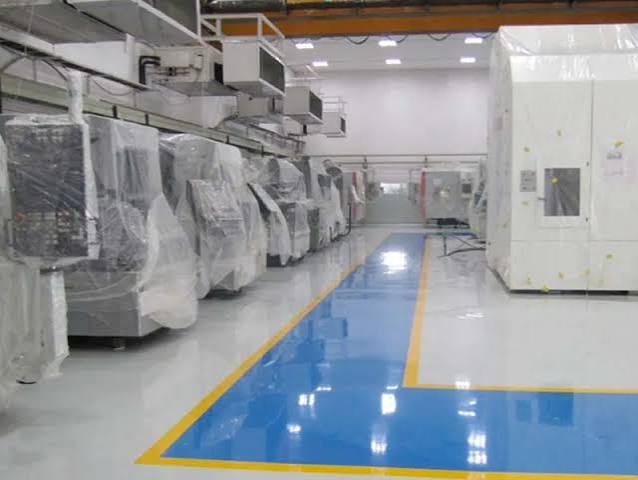
“`html
Manufacturing facility epoxy floor Amarillo: ESD, chemical-resistant, and urethane cement systems explained
⏱️ 5 min read · Last updated: 2026
- ESD resistance range: Static dissipative coatings measure 1×10⁶ to 1×10⁹ ohms; conductive coatings fall below 1×10⁶ ohms — both per ANSI/ESD S20.20 standards.
- Coating thickness: Standard broadcast epoxy systems run 20–40 mils total; urethane cement systems are typically applied at 3–6 mm (118–236 mils) for thermal and chemical durability.
- Load capacity: Cured industrial epoxy coatings commonly achieve compressive strength of 10,000–14,000 psi, suitable for most forklifts and heavy manufacturing equipment.
- Chemical resistance: High-build epoxy systems typically resist petroleum products, dilute acids, and most solvents per ASTM C267 immersion testing; concentrated acids (pH below 2) require urethane cement or novolac epoxy.
- Cost range in Amarillo, 2026: Industrial epoxy installs run approximately $3–$7 per sq ft; ESD systems add $1–$3 per sq ft; urethane cement systems typically run $8–$14 per sq ft installed.
A forklift dropped a pallet of chemical drums on a bare concrete floor at a food processing plant west of Amarillo — the spill damaged the slab surface in two spots within a week of repeated cleaning. The facility manager had been told a standard paint-grade floor coating would hold. It didn’t. Selecting the right manufacturing facility epoxy floor in Amarillo is not about finding the toughest product in a catalog. It is about matching the system to the specific stressors in each zone of your plant. Get that match wrong, and even the most expensive coating fails early. Get it right, and a properly spec’d floor can last a decade with minimal maintenance.
What epoxy system is best for a manufacturing plant floor?
The best system for a manufacturing facility epoxy floor in Amarillo is almost never a single product. It is a zone-mapped combination of systems, each matched to the chemical exposure, traffic load, and moisture conditions of that specific area. A receiving dock has different demands than an electronics assembly line, and a food processing wet room is nothing like a dry warehouse. Understanding those differences is the starting point for any good spec.
Here is how the four main industrial floor systems break down in practice:
| System | Best zone | Thickness (mils) | Key limitation |
|---|---|---|---|
| 100% solids epoxy broadcast | Warehousing, assembly | 20–40 mils | Degrades under thermal cycling above 140°F |
| ESD epoxy (static dissipative) | Electronics, flammable storage | 10–30 mils | Resistance values drift if grounding grid is omitted |
| Novolac epoxy | Chemical storage, mixing areas | 20–40 mils | More brittle than urethane cement; needs good substrate |
| Urethane cement system | Wet process, food/beverage, steam areas | 118–236 mils (3–6 mm) | Higher cost; requires more cure time |
If your plant has a single open floor plan with mixed uses, the most cost-effective approach is to mark zone boundaries and apply the right system within each one. A good contractor will walk the floor with you and identify high-risk transitions — those seams are where delamination most often starts. Once you have your zones mapped, the next question is whether any of them require ESD protection.

Do I need ESD flooring for my Amarillo facility?
Zone mapping naturally raises the question of ESD requirements. You need ESD flooring if your facility handles electronic assemblies, flammable vapors, or sensitive instrumentation where a static discharge could cause product damage, ignition, or a safety event. If your process falls under ANSI/ESD S20.20 or NFPA 77 guidelines, ESD flooring is part of the required control plan — not optional.
Static dissipative coatings are built to hold between 1×10⁶ and 1×10⁹ ohms of electrical resistance. That range moves static charge off the surface slowly and safely — fast enough to stop buildup before it causes a discharge, but controlled enough to avoid creating a shock hazard. Conductive floors, which measure below 1×10⁶ ohms, serve more specialized environments like explosive-atmosphere zones under NFPA 70.
Here is where Amarillo manufacturers often get this wrong: they install an ESD-rated coating but skip the copper grounding grid that goes beneath it. Without a continuous ground path tied to the building’s electrical ground, the coating’s resistance values are useless. The floor may pass a lab spec sheet but fail a field test with a surface resistance meter on day one.
ESD epoxy flooring without a verified grounding connection is like a seatbelt without a buckle — the component is present, but it cannot do its job.
If you are unsure whether your process triggers an ESD requirement, check your industry’s governing standard first. Electronics assembly falls under IPC-A-610. Pharmaceutical and medical device manufacturing often references ANSI/ESD S20.20. Fuel and flammable chemical handling falls under NFPA 77. Each standard specifies floor resistance requirements differently, so a contractor who quotes ESD without asking which standard applies is a warning sign.
For facilities that blend manufacturing and distribution under the same roof, compare what a warehouse epoxy floor coating Amarillo spec looks like versus a full ESD system — the two often overlap in ways that allow cost savings across zones. Once ESD zones are confirmed, the next layer of the spec is chemical resistance, which requires its own careful look.
How does epoxy handle chemical spills in manufacturing?
Standard 100% solids epoxy resists petroleum products, most solvents, dilute acids, and alkaline cleaners well. But concentrated acids below pH 2, ketones like acetone in large volumes, and chlorinated solvents can break down the epoxy matrix with repeated or prolonged exposure. The key variable is contact time, not just concentration — a strong acid wiped up immediately causes far less damage than a weak one left pooled for hours.
Per ASTM C267 immersion testing, epoxy systems are rated by weight gain, softening, and discoloration after a set soak period. A system rated “resistant” typically shows less than 1% weight gain after 7 days of immersion. When reviewing a product data sheet, ask for the actual test duration and weight gain numbers — not just a “resistant” label.
The failure mode most facility managers miss is edge degradation. A spill spreads to a floor drain, and the chemical pools at the cove base or drain collar — areas that are sometimes coated with a different product or left unsealed entirely. A chemical resistant epoxy floor system is only as good as its weakest termination point. For plants with drains, the spec must cover the drain collar, the cove base radius (minimum 3/4-inch at wall transitions), and any expansion joints. Expansion joints left filled with non-chemical-rated caulk are a common and avoidable failure point. Where concentrated chemicals are part of daily operations, standard epoxy starts to show limits — and that is where urethane cement becomes the right conversation.

Why urethane cement systems outperform standard epoxy in wet process areas
Where chemical exposure is heavy and thermal cycling is constant, urethane cement consistently outperforms standard epoxy. These systems bond directly to slightly damp concrete, tolerate continuous temperature swings, and stay flexible under the kind of impact loading that cracks brittle epoxy. In food processing, beverage production, and commercial kitchen environments, those properties are operational requirements — not nice-to-haves.
Urethane cement combines Portland cement with a urethane resin binder, creating a hybrid that behaves more like a troweled mortar than a painted coating. Applied at 3–6 mm (roughly 118–236 mils), it builds real profile — thick enough to resurface a deteriorated slab, not just coat it. That thickness also provides serious thermal shock resistance, which matters when you are hosing down a floor that reached 140°F from production equipment with 50°F water.
Standard epoxy, even high-build systems, commonly debonds when the temperature gap between coating and substrate exceeds about 50°F rapidly. Urethane cement handles that cycle without delaminating because its expansion rate is much closer to concrete’s. This is why most food-grade and pharmaceutical manufacturing specs in 2026 call for urethane cement in production zones and reserve standard epoxy for dry storage and office areas.
A urethane cement system applied at 4 mm will routinely outlast a 30-mil epoxy broadcast coat by two to three times in wet-process manufacturing environments — the difference is flexibility and thermal tolerance, not just thickness.
Cost is the honest trade-off. Urethane cement runs approximately $8–$14 per sq ft installed in Amarillo in 2026, versus $3–$7 for standard epoxy. For a 5,000 sq ft production zone, that gap is real money. But compare it to a full re-coat at the three-year mark — plus downtime — and the math often shifts. Once you understand system selection by zone, the next question is how each system gets installed correctly.
The correct way to install industrial epoxy — zone by zone
A proper industrial epoxy floor installation follows a sequenced process that corners-cut jobs skip in at least two stages. Here is what correct looks like, from slab to topcoat.
- Moisture testing first, always. Test MVER per ASTM F1869 or relative humidity per ASTM F2170 before opening any product. An MVER above 3 lbs per 1,000 sq ft per 24 hours requires a moisture-mitigating primer. Do not skip this in Amarillo — the region’s soil conditions make it a real risk, not a formality.
- Mechanical surface preparation. Grind or shot-blast the concrete to a CSP of 3–5 per ICRI 310.2 guidelines. Acid etching alone does not create enough mechanical profile for industrial epoxy. The surface should look like medium-grit sandpaper, not polished stone.
- Crack and joint repair. Route cracks wider than 1/16 inch and fill with a semi-rigid epoxy crack filler — not a flexible polyurethane. Flexible fillers under a rigid topcoat telegraph movement and create a failure line. Expansion joints get a chemical-rated flexible urethane sealant where the zone requires it.
- Prime coat application. Apply a penetrating epoxy primer at the rate on the product data sheet — typically 150–200 sq ft per gallon. Watch for pinholes as it cures; these signal outgassing from the slab and must be addressed before the body coat goes down. Do not overcoat a primer that has exceeded its recoat window.
- Body coat or broadcast layer. For broadcast systems, seed aggregate (typically aluminum oxide or quartz) into the wet coat until full rejection — the point where the surface stops absorbing aggregate and it begins to bounce off. This signals correct density. A thin broadcast wears unevenly and loses slip resistance fast.
- Topcoat at correct mil thickness. Apply the topcoat in two passes at 90 degrees to each other for uniform coverage. Measure wet film thickness with a mil gauge during application — do not rely on coverage calculations alone. Target the dry film thickness in the spec, typically 4–8 mils for a chemical-resistant topcoat.
- Cure time before traffic. Light foot traffic is generally safe at 24 hours. Forklifts need at least 72 hours. Full chemical resistance takes 7 days — and compressing that window is the most common reason floors show early chemical marking.
Getting installation right sets the floor up to perform. But even a perfect install fails early if the underlying slab cannot handle the loads your equipment puts on it — which brings us to thickness and load ratings.
Load rating and thickness: the specs most contractors skip telling you
Industrial epoxy coatings commonly achieve compressive strengths of 10,000–14,000 psi when fully cured — stronger than most concrete slabs beneath them. That means the slab itself is usually the limiting factor for point loads, not the coating. Specifying the right coating for forklift traffic is really a question about your slab first.
| Equipment type | Typical point load | Minimum slab spec | Recommended coating |
|---|---|---|---|
| Pedestrian / hand cart | Under 500 lbs | 3,000 psi concrete | Standard epoxy, 20 mils DFT |
| Electric sit-down forklift | 4,000–8,000 lbs | 4,000 psi concrete, 6-inch slab | High-build epoxy, 40 mils DFT |
| Pneumatic tire forklift | 10,000–20,000 lbs | 5,000 psi concrete, 8-inch slab | Broadcast epoxy or urethane cement |
| Overhead crane outrigger | Requires structural calc | Engineer-specified | Urethane cement or polymer concrete |
Coating thickness protects the slab from chemical attack and abrasion — but it does not add structural capacity to an undersized slab. If your concrete is already cracked or was poured thin, no coating system fixes that. A proper pre-install inspection should include a core sample or at least a rebound hammer test to confirm slab integrity before any coating work begins. With load capacity confirmed, the final step is making sure the overall spec doesn’t fall into the traps that consistently trip up manufacturing floor projects in Amarillo.
For facilities with office or retail areas adjacent to the production floor, the transition zones need their own spec. Load and aesthetic requirements diverge sharply, which is why commercial epoxy flooring Amarillo TX specifications differ from pure industrial systems — and why a contractor with experience in both is worth seeking out. If your facility also includes epoxy flooring for industrial facilities in Amarillo across multiple buildings or campuses, a consistent zone-mapping approach applied building by building prevents the patchwork failures that come from treating each structure in isolation.
The detail everyone gets wrong when specifying a manufacturing floor
The most common and costly mistake in manufacturing facility epoxy floor specification in Amarillo is treating the floor as one system when it is actually three or four systems in one building. Facility managers often select one product, apply it everywhere, and find within 18 months that the chemical zone is failing, the ESD zone never tested properly, and the dock area is delaminating from moisture. The zone map is not optional — it is the spec.
The second most common mistake is choosing by price per square foot instead of total lifecycle cost. A $4/sq ft standard epoxy that needs re-coating in three years in a wet zone costs more over ten years than a $10/sq ft urethane cement system that holds for eight. That pattern shows up consistently in facilities that did not zone their spec correctly the first time.
Beyond cost, there is a compliance dimension most specifications overlook. The static dissipative properties of an ESD floor must be verified with a field test, not assumed from the product data sheet. ANSI/ESD S7.1 defines the test method for floor materials, and ANSI/ESD S20.20 requires periodic re-verification — commonly quarterly or annually depending on your control plan. Installing an ESD-rated product and never testing it in place is a compliance gap that surfaces during audits.
In 2026, the most defensible manufacturing facility epoxy floor specification in Amarillo is a zone map, not a single product SKU — and any contractor who quotes one product for the whole building without asking about zones is skipping the most important part of the job.
Auto shops face a version of this same challenge with oil pits, drive-through bays, and customer areas all under one roof — which is why auto shop epoxy floor coating Amarillo specs also increasingly rely on zone-mapped systems. The principle scales directly to manufacturing. One more practical detail worth flagging: ambient temperature during application matters more than most product data sheets acknowledge. Most epoxy systems require substrate and air temperatures between 50°F and 90°F, with the substrate at least 5°F above the dew point. In an Amarillo facility in January or August, hitting those conditions without HVAC support during the cure window is genuinely difficult. Scheduling installation in spring or fall lowers the risk of cure failure and adhesion problems in ways that winter or summer installs simply cannot match.
Facilities that operate retail or customer-facing spaces attached to their manufacturing footprint sometimes need to bridge industrial and commercial specs — a scenario where retail store epoxy flooring Amarillo contractors with cross-sector experience
See also: commercial epoxy flooring Amarillo TX
See also: warehouse epoxy floor coating Amarillo
See also: retail store epoxy flooring Amarillo
Related: commercial epoxy floor cost Amarillo


